Transporting Waxy Crude Oil and Water in Core-Annular and Stratified Regimes
In this work, we performed a 3D numerical study of core-annular and stratified flows of waxy crude oil and water in inclined pipes with a gradual expansion. Waxy crudes are highly viscous crude oils with non-Newtonian flow behaviour, and transporting them efficiently is still a technical challenge. We examined core-annular and stratified transport of waxy crude in detail. The oil core flows in the laminar regime, while the water flow is turbulent. A volume-of-fluid model captures the oil/water interface, and a RANS turbulence model predicts the turbulent water flow. In the core-annular regime in an inclined pipe, the oil is treated as a viscoplastic fluid.
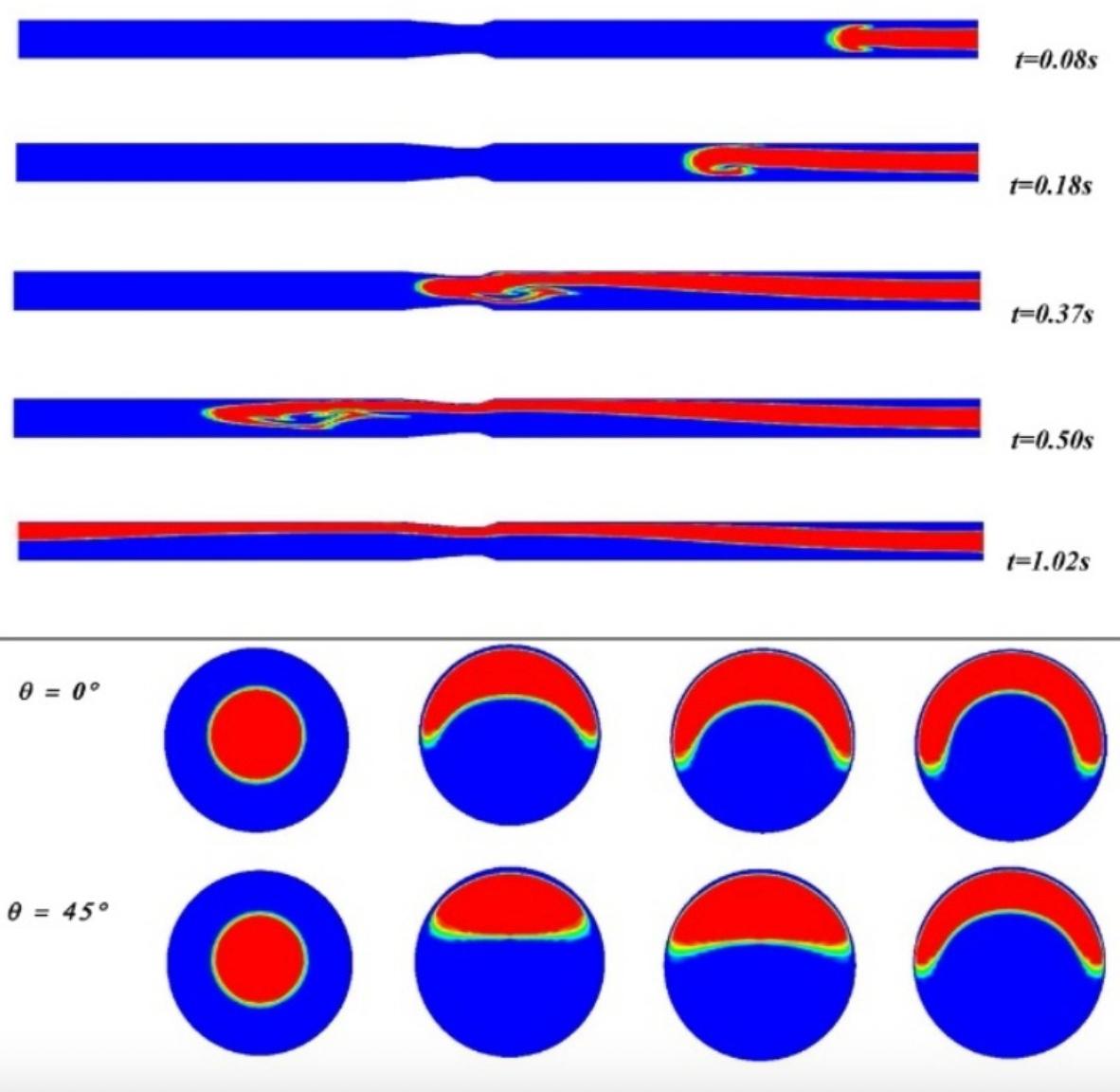
We varied the wax content of the crude oil, the inlet velocities, the expansion angle, and the inclination angle of the pipe. In the core-annular regime, the pressure drop along the pipeline did not change as the wax content increased, and core-annular transport became more economical than single-phase oil flow. Increasing the expansion angle in the core-annular regime from 3.7° to 45° raised the overall pressure drop more than fourfold. Transporting waxy crude at higher oil velocities can also be more economical. For downward flow, the overall pressure drop decreased monotonically as the inclination angle increased. In upward flow, the overall pressure drop as a function of inclination angle had a local maximum around 45°.
Related publications
- M.R. Daneshvar Garmroodi and A. Ahmadpour (2020). A numerical study on two-phase core-annular flows of waxy crude oil/water in inclined pipes. Chemical Engineering Research and Design, 159, 362–376.
- M.R. Daneshvar Garmroodi and A. Ahmadpour (2020). Numerical simulation of stratified waxy crude oil and water flows across horizontal pipes in the presence of wall heating. Journal of Petroleum Science and Engineering, 193, 107458.