Mixing in Heterogeneous Non-Newtonian Fluids
This study shows how far off mixing predictions can be when the heterogeneity of fluid properties is ignored. We look at the homogenization of an additive in a fluid-filled cylindrical tank stirred by an axisymmetric disk, where both the rheology and the density of the fluid depend on the additive concentration. We compare two models of how mixing develops. Model problem T includes the variation of the fluid properties with additive concentration, while model problem M replaces the fluid properties with their average values. In both, mixing is described by a concentration field governed by advection–diffusion.
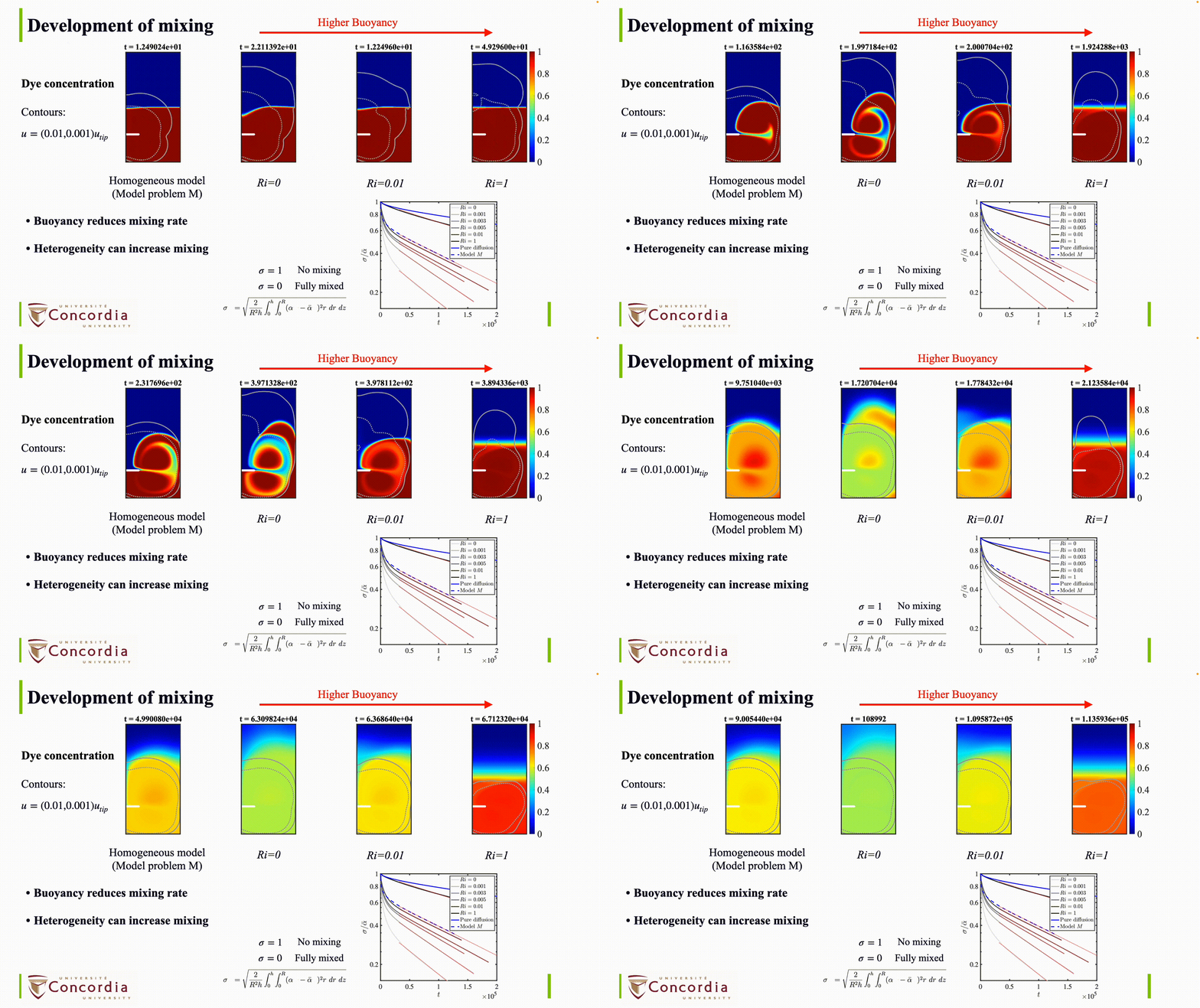
The mapping between the parameter spaces of the two model problems is far from one-to-one. For any point in the parameter space of model problem M, three parameter groups (buoyancy, Atwood number, and viscosity ratio) can vary freely within the corresponding subset of the parameter space of model problem T. As an example, we study how buoyancy changes the evolution of velocity and additive concentration, and we characterize its effect on the mixing rate through the asymptotic behaviour of the concentration field. The standard deviation of the concentration converges to an exponential decay, and both the intercept and the decay rate decrease as a power law of buoyancy, so even small variations in buoyancy change the mixing process considerably. Finally, the recirculation zones (regions where the fluid velocity is significant) do not coincide in model problems M and T.
Related publications
- M.R. Daneshvar Garmroodi and I. Karimfazli (2024). Mixing in heterogeneous fluids: An examination of fluid property variations. Journal of Non-Newtonian Fluid Mechanics, 325, 105196.