Learning and Controlling Contaminant Removal in Heterogeneous Porous Media
Ongoing research at McMaster University.
How fast a contaminant can be flushed out of the ground depends on a permeability field that we cannot see. In this project we study contaminant removal in a five-spot setup: clean fluid is injected at the centre and pushes the contaminant towards four corner outlets that can each be opened or closed. We run the experiments in a transparent cell whose engraved gap sets the permeability, and the simulations in OpenFOAM.
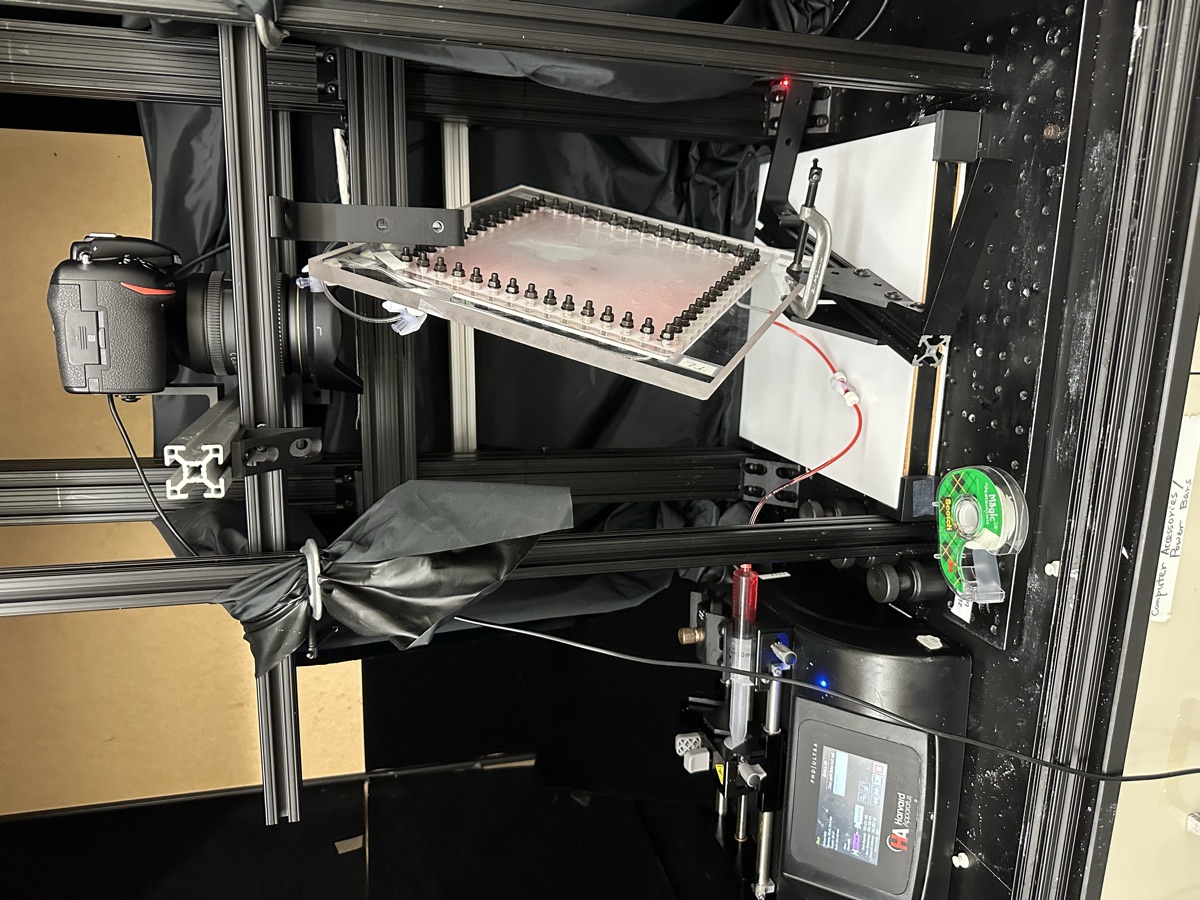
The goal is a digital twin that learns the hidden geology from a few sensors while the experiment runs, and then uses it to choose the injection rate and the open outlets so that the contaminant is removed with as little water as possible. It has two parts. A Fourier neural operator (FNO) predicts how the contaminant moves, much faster than the full simulation, and a recurrent network estimates the permeability map and its uncertainty from the sensor readings. Together they will drive a model predictive controller.