Viscoelastic Hollow Droplets
Hollow droplets matter in applications such as coating and spraying, but their impact has been studied far less than that of dense droplets, especially for non-Newtonian fluids. This experimental work, with M.M. Nasiri, looks at the impact of hollow Newtonian (water) and viscoelastic (polymer solution) droplets on a solid surface.
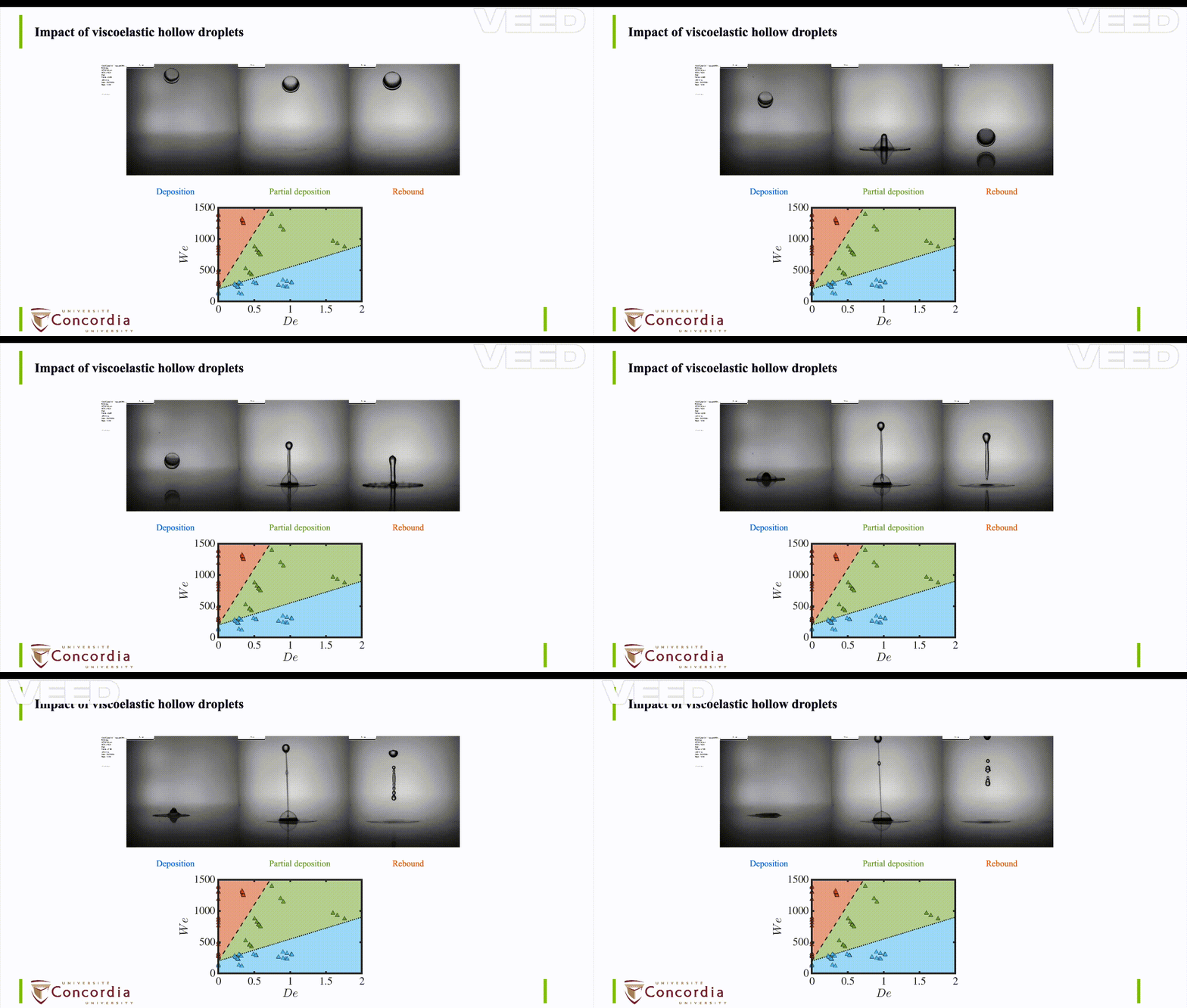
Hollow droplet flattening has two characteristic features: a central counter-jet forms, and the droplet deposits on the surface. Both come from the rupture of an entrapped air bubble. For Newtonian impacts, the counter-jet grows quickly and breaks up through capillary instabilities. Adding polymer changes this behaviour. Viscoelasticity lowers the counter-jet’s height and velocity through increased viscous dissipation, delays bubble rupture, and prevents the droplet from detaching. We also see beads-on-a-string structures as the filament thins, a sign of competition between elastic and capillary forces.
By varying the polymer concentration and impact velocity, we built a regime map (deposition, partial deposition, rebound) in the Weber–Deborah number plane. The results show how inertia, viscosity, capillarity, and elasticity together set the splashing morphology of hollow non-Newtonian droplets.
Related publications
- M.M. Nasiri, M.R. Daneshvar Garmroodi, D.C. Vadillo, and M. Tembely. Experimental study of the impact of a hollow polymer droplet. Submitted to Physics of Fluids.